
How Much Will Product Photography Cost in 2026?
Product photography continues to play a direct role in how products are perceived, compared and chosen online.
As digital storefronts become more visual and competitive, brands are paying closer attention to image quality, consistency and scalability. This has naturally raised questions about pricing especially as tools, workflows and buyer expectations evolve.
The truth? Pricing varies widely. Costs can range from relatively affordable per-image rates to several thousand dollars for a full shooting day.
This wide gap often creates confusion, especially for brands that work with both independent photographers and premium studios. Quotes can be difficult to compare, deliverables are not always clearly defined and higher prices do not automatically guarantee better value.
Looking ahead to 2026, product photography pricing will be shaped by multiple factors i.e. shooting style, volume, location, licensing needs and the growing influence of automation and AI-based solutions.
This guide breaks down how providers structure their pricing, how pricing models work and what drives costs up or down so budgeting decisions are based on clarity rather than guesswork.
Table of Contents
Quick Answer: What to Expect in 2026?
Before diving into details, here’s a rough idea of what most eCommerce brands can expect.
Basic product photography (white background): $25 to $75 per image
Mid-range product photography (professional styling, props, multiple angles): $50 to $150 per image
Premium lifestyle photography (models, complex sets, creative direction): $250+per image
Full-day studio shoots: $1,500+ depending on scope and provider
AI-enhanced product photography (studio photos + AI variations): 60% to 80% less than traditional production for equivalent output
Product photo editing service (professional photo editing partner): Starting from $0.25 depending on complexity
These ranges are meant as starting points. Your actual costs will depend on factors such as project complexity, scope and the photography company you choose which we’ll explore throughout this guide.
Understanding Service Provider Options
Product photography providers vary widely in terms of scale, experience and capabilities.
In the United States alone, there are currently an estimated 148,900 photographers with the job market expected to grow by 4.1% between 2022 and 2032.
For business owners and marketing teams, the challenge is not understanding photography theory but rather choosing the right provider for their eCommerce needs.
In practice, product photography services usually fall into three main categories. These are independent photographers, professional photography studios and AI-enhanced services.
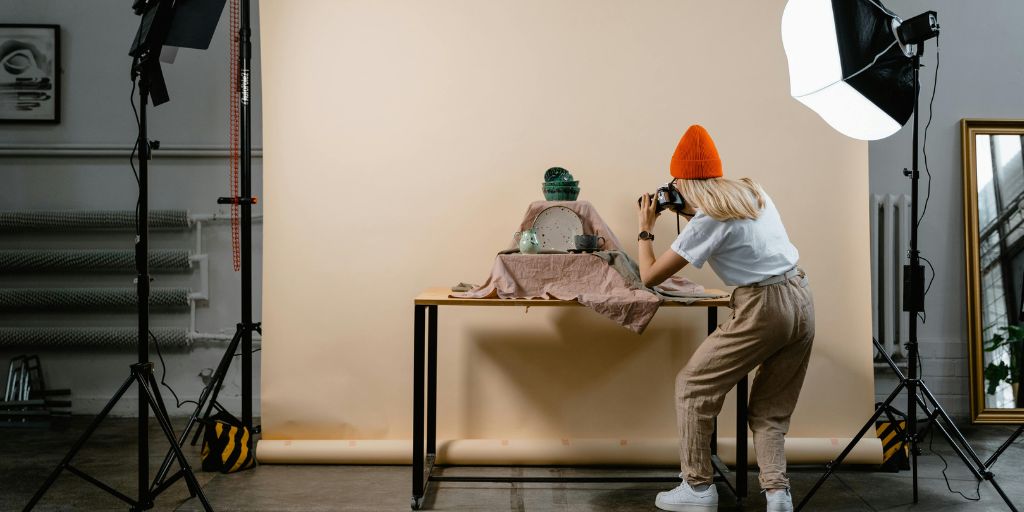
Working With Independent Photographers
Advantages:
- Well-suited for smaller brands or one-off projects
- More flexible pricing due to the irregular nature of incoming leads
- Larger pool of photographers to choose from
- Lower shipping costs when the photographer is located nearby
Limitations:
- Skill level and experience can vary significantly
- May lack access to specialized equipment or professional studio setups required for certain products
- Less consistency if you need to scale across multiple product lines
Working With Professional Photography Studios
Advantages:
- Greater consistency and scalability
- Reliable results supported by full studio facilities and professional-grade equipment
- Ability to handle high product volumes, items of all sizes and complex shoots that require structured workflows
- Often include product photo editing services in-house or through trusted partners
Limitations:
- Fewer provider options compared to independent photographers
- Higher pricing than freelancers
- Potentially higher shipping costs if the studio is located far from your warehouse
AI-Enhanced Photography Services

A growing option for 2026 combines real studio photography with AI tools.
Products are photographed professionally first, then AI generates variations, adjusts backgrounds, modifies lighting and adapts images for different formats and platforms.
Advantages:
- Reduces costs by roughly 60% to 80% compared to traditional studio production for the same range of outputs
- Faster turnaround for multi-format content
- Ideal for consistency across large catalogs
Limitations:
- Less suitable for flagship visuals that define your brand identity
- May lack the extreme detail and texture accuracy needed for print or luxury products
- Still an emerging approach so quality varies between providers
How Providers Structure Their Pricing?
Understanding how providers structure their pricing helps you compare quotes more effectively and choose the model that matches your workflow.
Most photography services use one of three approaches. These are image-based pricing, time-based pricing or subscription models.
Let’s look at real examples to see how these work in practice.
Factual Product Photography Pricing 2026
Example 1: Squareshot
Squareshot offers three pricing structures.
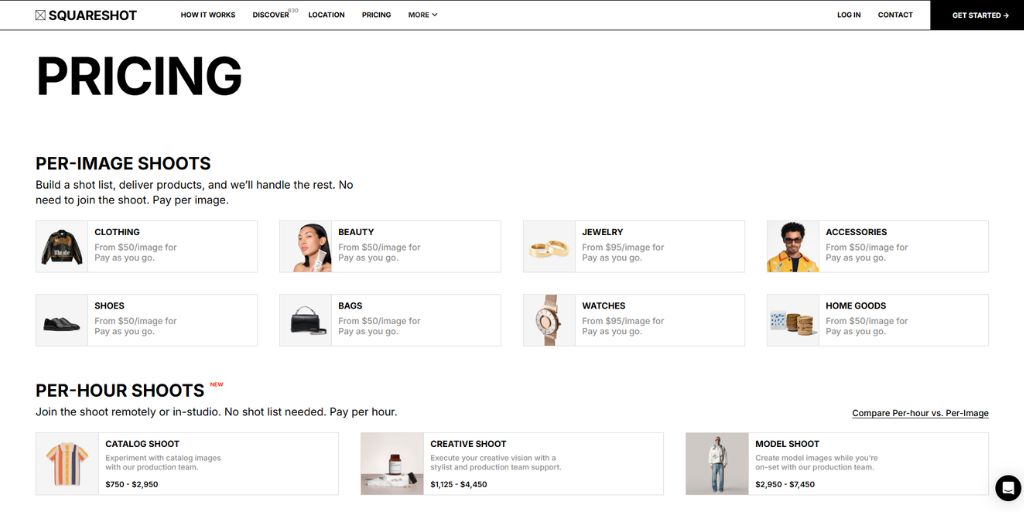
Per-Image Pricing
You pay for a specific number of images with pricing based on each final edited photo.
Best for: Brands with a specific project scope and a defined shot list.
This is the most straightforward, transparent model and is fair for both clients and photographers. It works well if you already know exactly what you need whether that is clothing, beauty, jewelry, accessories, shoes, bags, watches or home goods.
Pros:
- Low upfront costs
- Pay only for what you need
- No extra costs for delays or surprises
- Easy to budget and scale
Cons:
- Less control of the creative process
- Less flexibility for last-minute changes
- Costs increase proportionally with more images
Per-Hour or Per-Day Pricing
You pay for studio time (commonly 2, 4 or 8 hours) including prep, shoot, lunch and wrap-up with a full team and equipment.
Best for: Brands that want to experiment with different lighting, styling, angles and shot variations without a fixed image count.
This gives you more creative freedom to try different ideas during the session whether that is a catalog, a creative and model shoot.
Pros:
- More control of the process
- More creative freedom
- No image limit during your booked time
- All raw shots provided
Cons:
- Higher upfront cost
- A kick-off call is usually required
- On-set presence required
- Changes or delays can add extra costs
Membership or Subscription Pricing
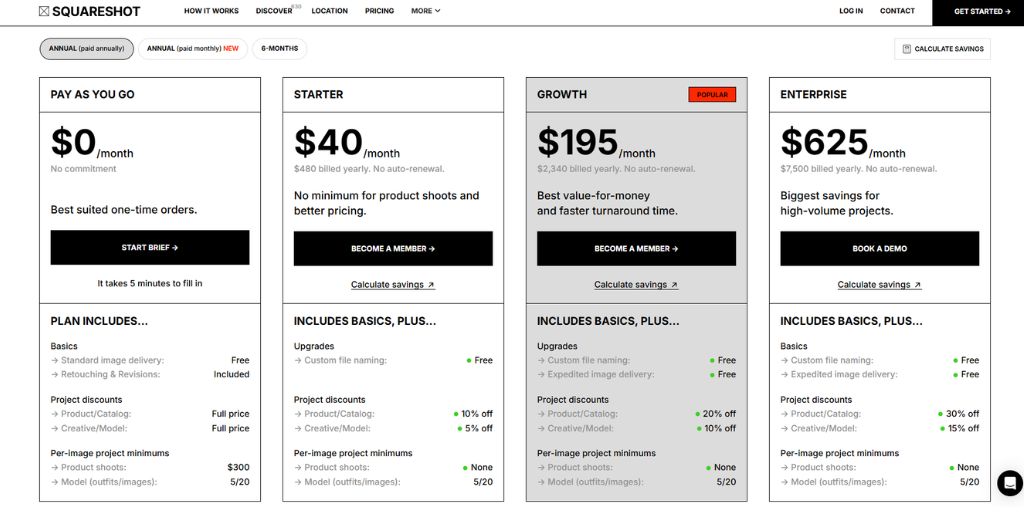
You subscribe to a membership that offers reduced rates on product and model photography, faster image delivery and no minimum order requirement for product shots.
Best for: Brands with ongoing, recurring photography needs throughout the year.
Plans typically range from a free pay-as-you-go option to paid tiers such as Starter ($40/month), Growth ($195/month) and Enterprise ($625/month) with billing available monthly, semi-annually or annually.
Pros:
- No minimum for product shoots and better pricing
- Best value-for-money and faster turnaround time
- Biggest savings for high-volume projects
Cons:
- Requires commitment to get the best value
- May pay for features you do not use if your needs are sporadic
Example 2: Soona
Soona is an all-in-one content creation platform designed for eCommerce brands that need fast, affordable and scalable visuals.
It offers virtual photoshoots where brands can direct photographers in real time, receive next-day edits and manage assets using built-in AI tools.
Plans & Pricing
Studio Pass
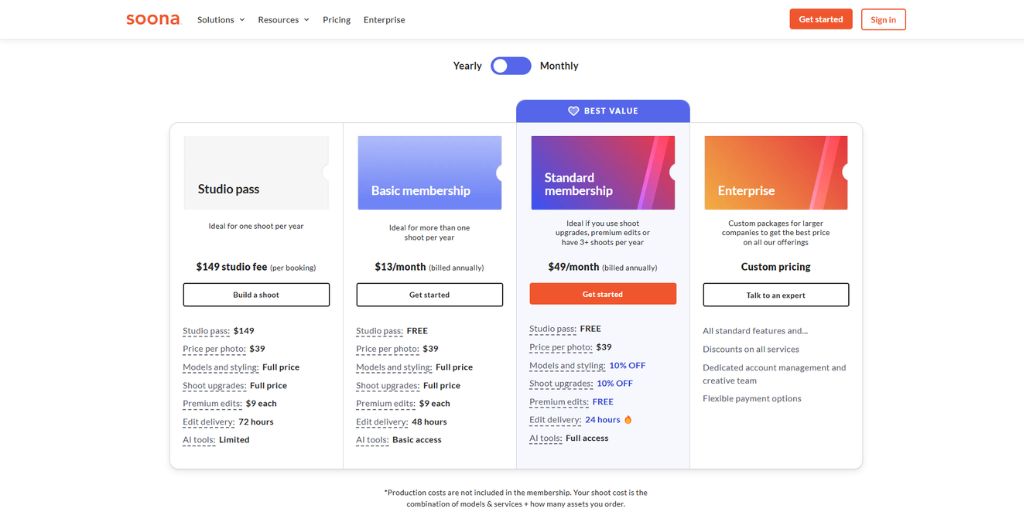
The Studio Pass is a one-time option priced at $149 per booking, ideal for brands that need a single shoot per year.
It includes access to Soona’s studios, backdrops, lifestyle sets, props and creative talent along with basic product assembly, light steaming and return handling.
Images are purchased separately at $39 per photo with premium edits available for an additional $9 per image. AI tools are limited.
Basic Membership
The Basic Membership is best for brands that need more than one shoot per year but have minimal editing or upgrade needs.
It costs $13/month (billed annually) and includes a free Studio Pass, image pricing at $39 per photo and basic access to AI tools.
Models, styling, shoot upgrades and premium edits are available at full price.
Standard Membership (Best Value)
The Standard Membership is ideal for brands with regular photography needs.
Priced at $49/month (billed annually), it includes a free Studio Pass, images at $39 per photo, free premium edits, 10% off models, styling and shoot upgrades, faster 24-hour edit delivery and full access to AI tools.
Enterprise
Enterprise plans offer custom pricing for larger brands.
These plans include all Standard features, discounted services across the platform, dedicated account management, creative support and flexible payment options.
Plan Recommendations
- Studio Pass: Best for brands that need only one shoot per year
- Basic Membership: Ideal for brands with occasional shoots and basic AI tool needs
- Standard Membership: Best for brands with three or more shoots per year or those using upgrades and premium edits regularly
- Enterprise: Designed for large teams seeking volume discounts and hands-on support
What Drives Product Photography Costs Up or Down?
Understanding what influences pricing helps you make smarter decisions and negotiate more effectively.
Volume
Higher quantities typically lower the per-image cost. Photographers and studios offer volume discounts because setup and workflow become more efficient.
Complexity
Simple white-background shots cost less than lifestyle images with models, props, styling and complex lighting. Each additional element adds time and expertise.
Turnaround Time
Rush orders command premium pricing. Standard turnaround costs less than next-day delivery.
Usage Rights and Licensing
How and where you plan to use the images matters. Broader usage rights (unlimited platforms, extended duration, multiple regions) increase costs. Limited usage rights (single platform, short campaign) cost less.
Location and Shipping
Local photographers save on shipping costs. Remote studios may require you to ship products, adding expense and logistics complexity.
Editing Requirements
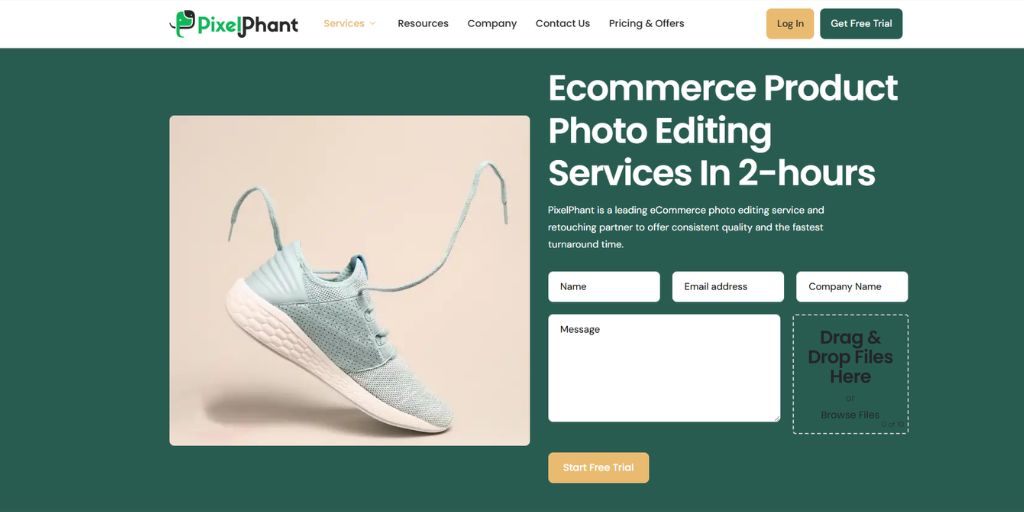
Basic editing (color correction, background removal) is often included. Advanced retouching, shadow creation and complex compositing add to the price.
Many brands now outsource to a professional photo retouching service like PixelPhant to control costs while maintaining quality.
The Hidden Value of Outsourcing Product Photo Editing
One trend gaining momentum in 2026 is separating shooting from editing.
Brands work with photographers for the actual photoshoot, then send raw files to dedicated product photo editing services for post-production.
Why Does This Work?
- Photographers can focus on what they do best i.e. capturing images
- Editing specialists deliver consistent, high-quality results at lower rates
- Brands maintain better control over style and turnaround times
- Costs become more predictable and scalable
These professional services specialize in eCommerce product photo editing, handling everything from background removal and color correction to shadow creation and advanced retouching.
This approach often reduces overall costs by 30% to 50% compared to bundled photography packages while improving consistency across large catalogs.
What Does a Complete Project Actually Cost?
Understanding individual pricing models helps but most brands want to know the cost of an entire project.
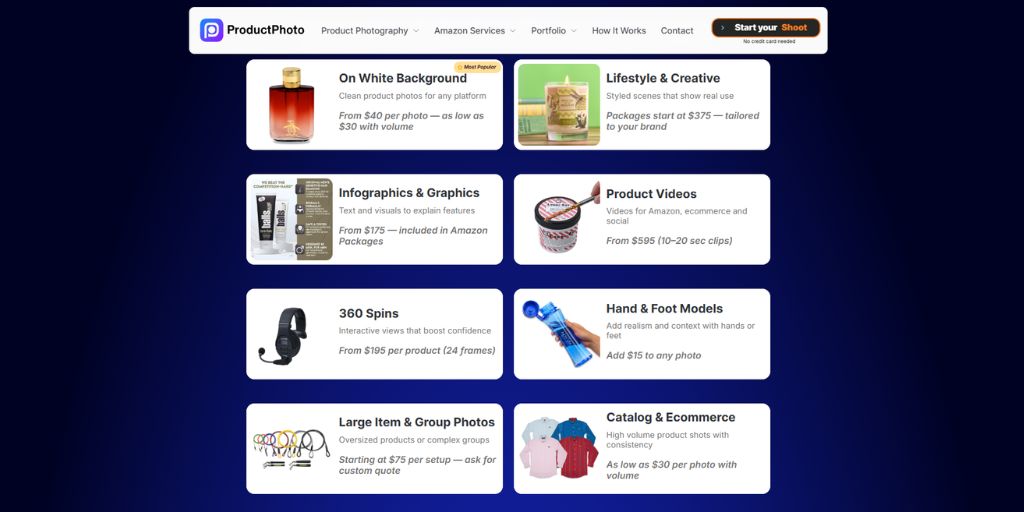
So, here we’ll look at four realistic scenarios from ProductPhoto so you can see approximately how much a project like yours might cost.
Scenario 1: Small-Size (1-10 Images)
Your situation: You’re launching a small-size home goods brand line with 10 products. Each needs:
- 5 White background images
- 5 Lifestyle & creative images
- Total images needed: 10
Option A: On-White
5 white background images × $40 (based on volume tier) = $200
| Note: Includes high-resolution, eCommerce-ready, pure white backgrounds, 7-10 business day turnaround, unlimited royalty-free usage license. |
Option B: Lifestyle Product
5 Lifestyle & creative images × $375 (starting price) = $1,875
Final Total Cost: $2,075
| Note: Includes 7-10 business day turnaround, unlimited use, optimized for Amazon, Shopify, and more, stock and studio composites and AI-assisted creatives |
Scenario 2: Mid-Size (11-50 Images)
Your situation: You’re launching a mid-size home goods brand line with 50 products. Each needs:
- 25 White background images
- 25 Lifestyle & creative images
- Total images needed: 50
Option A: On-White
25 white background images × $35 (based on volume tier) = $875
| Note: Includes high-resolution, eCommerce-ready, pure white backgrounds, 7-10 business day turnaround, unlimited royalty-free usage license. |
Option B: Lifestyle Product
25 Lifestyle & creative images × $375 (starting price) = $9,375
Final Total Cost: $10,250
| Note: Includes 7-10 business day turnaround, unlimited use, optimized for Amazon, Shopify, and more, stock and studio composites and AI-assisted creatives |
Scenario 3: Large-Size (51+ Images)
Your situation: You’re launching a mid-size home goods brand line with 150 products. Each needs:
- 75 White background images
- 75 Lifestyle & creative images
- Total images needed: 150
Option A: On-White
75 white background images × $30 (based on volume tier) = $2,250
| Note: Includes high-resolution, eCommerce-ready, pure white backgrounds, 7-10 business day turnaround, unlimited royalty-free usage license. |
Option B: Lifestyle Product
75 Lifestyle & creative images × $375 (starting price) = $28,125
Final Total Cost: $30,375
| Note: Includes 7-10 business day turnaround, unlimited use, optimized for Amazon, Shopify, and more, stock and studio composites and AI-assisted creatives |
Scenario 4: High Volume eCommerce Catalog (51-500 Images)
Your situation: You’re launching a high-volume eCommerce brand line with 500 products. Each needs:
- 500 White background images
- Total images needed: 500
Option A: On-White
500 white background images × $30 (based on volume tier) = $15,000
| Note: Includes high-resolution, eCommerce-ready, pure white backgrounds, 7-10 business day turnaround, unlimited royalty-free usage license. |
Final Total Cost: $15,000
Amazon Listing Packages
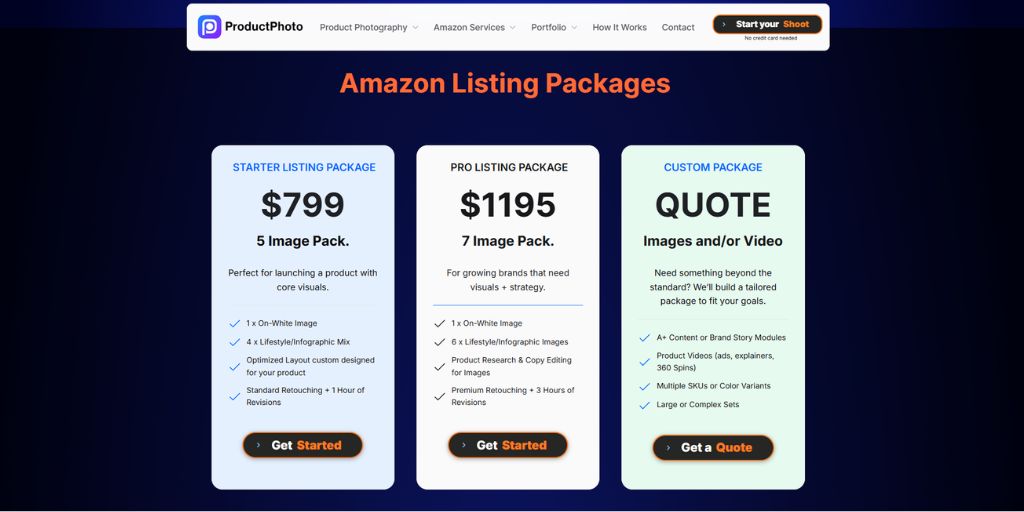
Starter Listing (5 image pack at $799)
Best for: Perfect for launching a product with core visuals
- 1 x On-White Image
- 4 x Lifestyle/Infographic Mix
- Optimized Layout Custom Designed for your Product
- Standard Retouching + 1 Hour of Revisions
Pro Listing Package (7 image pack at $1195)
Best for: For growing brands that need visuals + strategy
- 1 x On-White Image
- 6 x Lifestyle/Infographic Images
- Product Research & Copy Editing for Images
- Premium Retouching + 3 Hours of Revisions
Custom Package (Get a Quote)
- A+ Content or Brand Story Modules
- Product Videos (ads, explainers, 360 Spins)
- Multiple SKUs or Color Variants
- Large or Complex Sets
2026 Trends Shaping Product Photography Costs
Several emerging trends will influence what you pay for product photography in 2026 and beyond.
Increased Automation
More studios are adopting automated photography systems that capture consistent shots faster.
This reduces labor costs and speeds up turnaround, potentially lowering prices for high-volume orders.
AI Integration
AI tools for background generation, lighting adjustments and style variations are becoming standard.
Expect hybrid pricing models where you pay for studio photography plus AI enhancements as add-ons.
On-Demand Platforms
Subscription-based platforms that connect brands with photographers and editors on demand are growing.
These marketplaces introduce price transparency and competition which can benefit buyers.
Specialization
As the market matures, more providers are specializing in specific product categories (apparel, food, electronics).
Specialists often deliver better results but may command premium pricing.
Remote Direction
Technology that allows brands to direct photoshoots remotely is reducing travel costs and making national or international collaborations more feasible.
How to Choose the Right Product Photography Solution?

With so many options, how do you decide? Follow this simple framework:
Start with your budget and volume. If you are launching with fewer than 20 products and have a tight budget, independent photographers or AI-enhanced services offer the best value. For larger catalogs or ongoing needs, studios and subscription models make more sense.
Consider your quality requirements. Flagship products and hero images justify premium photography. Every day catalog shots can use more affordable options or AI enhancements.
Think about turnaround time. If you need images quickly and consistently, platforms with fast delivery and dedicated editing teams (or outsourced product photo editing partners) work better than booking individual shoots.
Evaluate your internal capacity. Do you have time to manage multiple photographers, review raw files and coordinate editing? If not, full-service studios or all-in-one platforms simplify the process.
Test before committing. Most providers offer sample shoots or trial projects. Use these to assess quality, communication and workflow fit before signing larger contracts.
Making Product Photography a Strategic Investment
Product photography is not just an expense; it is a strategic investment in how customers perceive your brand.
Poor images cost you sales. Exceptional images build trust, increase conversions and justify premium pricing.
The most effective approach in 2026 is not choosing the cheapest option but selecting the right level of photography that supports product presentation, brand consistency and long-term growth.
Here is What That Looks Like in Practice:
Audit your current images. Identify which products need refreshed photography and which are performing well. Prioritize based on sales impact.
Create a style guide. Define your visual standards for lighting, angles, backgrounds and editing. This ensures consistency whether you work with one provider or many.
Build relationships with reliable providers. Long-term partnerships with photographers and product photo editing services lead to better pricing, faster turnaround and a deeper understanding of your brand.
Invest in quality editing. Even excellent photography falls short with poor post-production. Whether you handle editing in-house, bundle it with your photographer or outsource, make editing a priority.
Plan for scale. As your catalog grows, your product photography workflow should grow with it. Subscription models, automated systems and AI-enhanced services help you scale without proportional cost increases.
Take the Next Step
Understanding product photography costs is the first step. The next is taking action.
Whether you’re launching a new product line, refreshing your catalog or scaling your eCommerce operation, now is the time to evaluate your photography needs and budget strategically.
Request quotes from two to three providers that match your volume and quality requirements and compare more than just price consider turnaround time, usage rights, editing quality and revision policies.
For greater flexibility and cost control, consider splitting your workflow by working with photographers for image capture and professional editing services for consistent, scalable post-production.
This approach delivers predictable costs, greater control and room to grow.
Product photography in 2026 offers more options than ever. The brands that succeed treat visual content as a strategic investment.
Now that you know product photography puts you ahead, make sure yours pays off in 2026.